Brake Heat and Fade on Heavy Trucks: The Energy Math
Brake fade is an energy problem. This page calculates how much heat a loaded truck puts into its brakes across common speeds and grades, and shows where the heat does damage.
- One full stop of an 80,000-lb truck from 65 mph: about 15.3 MJ into the brakes.
- A 5-mile, 6% descent: about 172 MJ — roughly 11× a stop.
- Air disc brakes run up to about 600°F in normal service (Meritor).
- Phenolic binders begin to carbonize around 450°C / 840°F (Motta et al., 2023).
- Choose a low gear before the descent and use the engine retarder (SGI).
How much energy do a loaded truck’s brakes absorb?
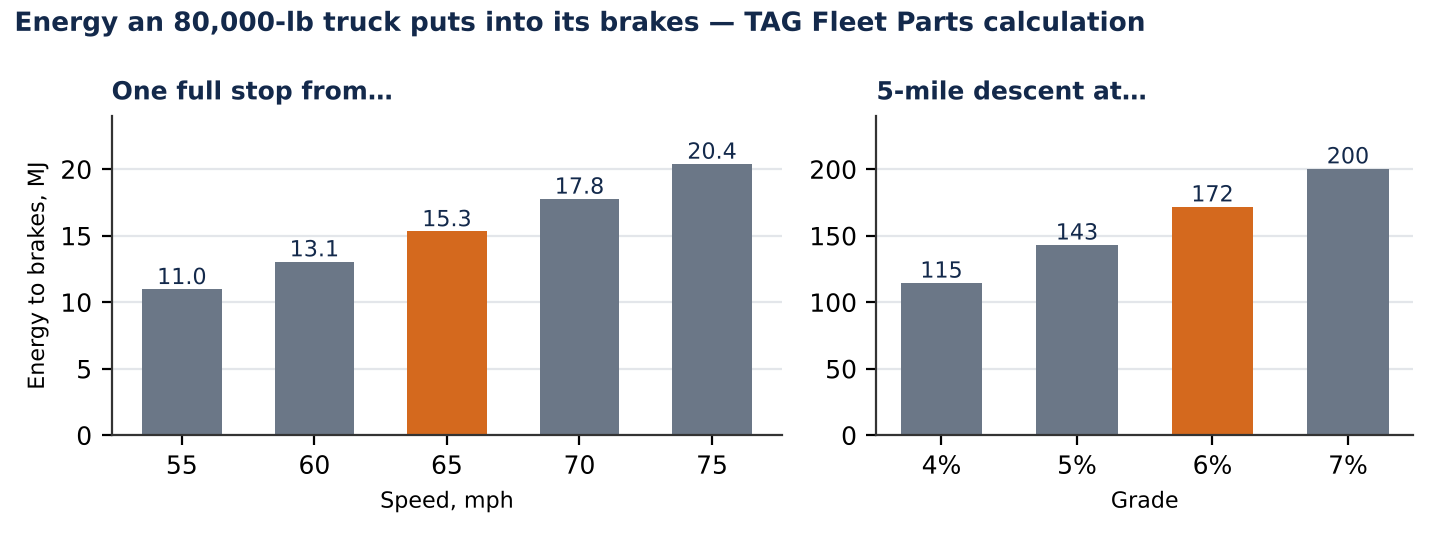
Mass: 80,000 lb = 36,287 kg   (federal GVW limit, 23 CFR 658.17)

Full stop from 65 mph (29.06 m/s)
  E = ½ · m · v² = ½ × 36,287 × 29.06² ≈ 15.3 MJ

5-mile descent at 6% (vertical drop 483 m)
  E = m · g · h = 36,287 × 9.81 × 483 ≈ 172 MJ  ≈ 11× a stop
How hot do air disc brakes get?
In normal service air disc brakes run from ambient up to about 600°F (≈315°C), versus about 300°F for drum brakes in the same application (Meritor, via Fleet Equipment). The highest brake temperatures occur when braking from highway speed on long downgrades (SGI).
What happens to the pad when it overheats?
The friction material’s phenolic resin binder begins to carbonize around 450°C (840°F), which lowers density, raises porosity and reduces structural integrity (Motta et al., Materials, 2023). Too much heat can result in brake fade, brake damage or brake failure (SGI Professional Driver’s Handbook).
How do drivers prevent brake fade?
- Select a gear low enough to control speed before starting down the grade (SGI).
- Use the engine retarder (engine brake) to save the service brakes for stopping (SGI) — but be cautious with it on slippery roads, where it can lock the drive wheels.
- Use pads with the friction band the brake was designed for; see edge codes.
For reference, FMVSS 121 requires a loaded truck-tractor to stop from 60 mph within 250 ft, or 310 ft for three-axle tractors over 70,000 lb and four-or-more-axle tractors over 85,000 lb GVWR.
Frequently asked questions
How much energy does a loaded semi’s brakes absorb?
By TAG Fleet Parts’ calculation, a full stop of an 80,000-lb truck from 65 mph converts about 15.3 MJ into heat, and a 5-mile, 6% descent releases about 172 MJ. Drag, rolling resistance and the engine brake take part of that load, which is why the engine brake should carry the grade.
How hot do air disc brakes get?
In normal service, air disc brakes run up to about 600°F (≈315°C), versus about 300°F for drum brakes, according to Meritor via Fleet Equipment. Long downgrades at highway speed produce the highest temperatures.
What causes brake fade?
Too much heat. Heat builds fastest when braking from highway speed on long downgrades. In the pad, the phenolic binder begins to carbonize around 450°C (840°F), weakening the friction material.
How do you prevent brake fade on a downgrade?
Select a gear low enough to control speed before the descent and use the engine retarder, keeping the service brakes for stopping (SGI Professional Driver’s Handbook).
Heavy-Duty Air Disc Brake Pads: Materials, Regulation & Field Performance.
Educational content, not engineering advice. Always follow the caliper and vehicle manufacturer's approved friction specification for your vehicle.