Copper-Free Brake Pads and the LeafMark: What Heavy-Duty Fleets Need to Know
California and Washington cap copper in brake friction material at 0.5% since 2025. Here is what the rules require, why they exist, how they apply to heavy trucks, and how to verify a part.
- Under 5% copper from 2021; no more than 0.5% from 2025 (California SB 346; Washington Better Brakes Law).
- California’s law covers heavy-duty vehicles over 26,000 lb, with heavy-duty extensions possible to January 1, 2032.
- LeafMark levels: A (one leaf), B (two leaves, under 5% copper), N (three leaves, all 2025 requirements).
- EPA estimates brakes released about 1.3 million lb of copper into California’s environment in 2010.
Why was copper removed from brake pads?
EPA estimates that before the state requirements, brake dust released about 1.3 million pounds of copper into California’s environment (2010) and about 250,000 pounds into Washington’s (2011). Copper in stormwater affects fish, amphibians, invertebrates and plants. A study with NOAA collaborators found that copper at 5 parts per billion impaired juvenile coho salmon’s sense of smell: exposed fish failed to detect an alarm cue and were attacked after about 5 seconds on average, versus about 30 seconds for unexposed fish (McIntyre et al., Ecological Applications, 2012).
What do the copper rules require?
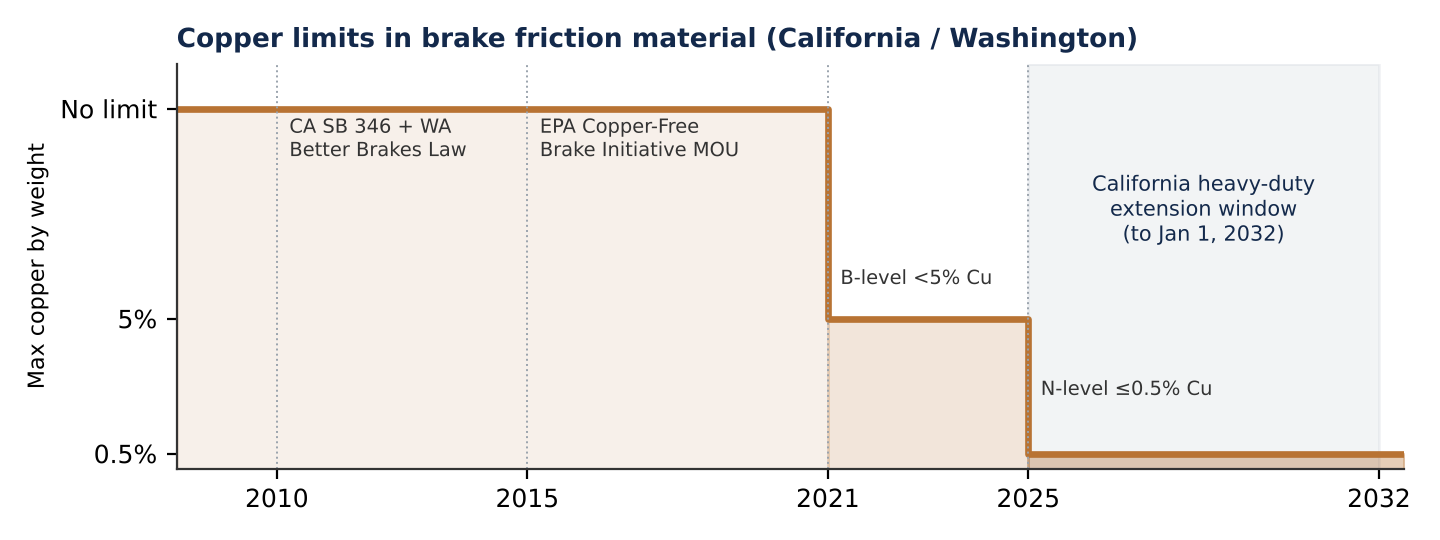
| Date | Requirement | Source |
|---|---|---|
| 2010 | California SB 346 and Washington’s Better Brakes Law enacted | State law |
| 2014 | Cadmium ≤0.01%; chromium(VI) salts, lead, mercury, asbestiform fibers ≤0.1% | California SB 346 |
| Jan 21, 2015 | EPA, the states and eight industry groups sign the voluntary Copper-Free Brake Initiative | US EPA |
| 2021 | Under 5% copper by weight | CA / WA |
| 2025 | No more than 0.5% copper by weight | CA / WA |
| Jan 1, 2032 | Latest possible California heavy-duty extension | California SB 346 |
The industry signatories to EPA’s initiative include the Heavy Duty Manufacturers Association and the Truck and Engine Manufacturers Association.
Do the copper rules apply to heavy trucks?
Yes. California’s law defines heavy-duty vehicles as over 26,000 lb and has no weight-based exemption. It lets manufacturers apply for one- to three-year extensions of the 2025 deadline; after 2030 only heavy-duty friction makers may apply, with extensions reaching January 1, 2032. Its exemptions include vehicles built before each deadline, motorcycles, military tactical vehicles, brakes designed mainly to hold a vehicle stationary, and fully enclosed oil-immersed brakes.
What do the LeafMark levels mean?
| Mark | Meaning (Washington Dept. of Ecology) |
|---|---|
| A — one leaf | Asbestos, cadmium, chromium, lead and mercury limited (2015 requirements) |
| B — two leaves | Level A, plus under 5% copper by weight (2021 requirements) |
| N — three leaves | All requirements met (2025 requirements) |
Manufacturers certify compliance to Ecology from accredited-laboratory tests, and proof of certification must appear on pads and packaging sold in Washington.
Frequently asked questions
Do copper-free brake pad laws apply to heavy-duty trucks?
Yes. California’s law covers heavy-duty vehicles over 26,000 lb with no weight exemption, but heavy-duty friction makers may apply for extensions through January 1, 2032.
What does the LeafMark N mean?
Three leaves (N) mean the friction material meets all 2025 requirements of Washington’s Better Brakes Law, including no more than 0.5% copper. One leaf (A) covers the heavy metals and asbestos limits; two leaves (B) add the under-5% copper limit.
When did brake pads have to be copper-free?
Under 5% copper from 2021 and no more than 0.5% copper from 2025, in California and Washington.
Why was copper banned in brake pads?
Copper from brake dust reaches waterways through stormwater and harms aquatic life. EPA estimates brakes released about 1.3 million pounds of copper into California’s environment in 2010, and research found copper at 5 ppb impairs juvenile coho salmon’s sense of smell.
Heavy-Duty Air Disc Brake Pads: Materials, Regulation & Field Performance.
Educational content, not engineering advice. Always follow the caliper and vehicle manufacturer's approved friction specification for your vehicle.