Heavy-Duty Air Disc Brake Pads: The Complete Guide
Air disc brakes now equip more than half of new North American Class 6–8 vehicles. This guide explains what their pads are made of, why copper left the formula, how much heat a loaded truck puts into its brakes, how corrosion ends pad life early, and what to check before you buy.
- Air disc adoption on North American Class 6–8 vehicles passed 50% by July 2024, up from about 25% in 2018 (Bendix).
- A disc pad has one-half to one-third the area of a drum lining and absorbs 2–3× the energy per square inch (SAF-Holland, via Fleet Equipment).
- Air disc pads are semi-metallic, with more than 50% ferrous content (Fleet Equipment).
- Copper in friction material is capped at 0.5% in California and Washington since 2025; California heavy-duty extensions can run to January 1, 2032.
- Replace air disc pads at 3 mm of friction above the backing plate (WABCO).
What is a heavy-duty disc brake pad made of?
A disc pad is friction material attached to a steel backing plate. The friction material is a composite of reinforcing fibers, fillers, friction modifiers and lubricants held together by a binder — most often a phenolic resin, chosen for its performance-to-price ratio and how well it wets the other ingredients, but brittle and limited in heat resistance (Motta et al., Materials, 2023). The friction is either bonded to the plate with adhesive or mechanically attached; mechanical attachment is stronger than adhesive alone (Fleet Equipment, 2022).
Why does a disc pad work harder than a drum lining?
An air disc pad has roughly one-half to one-third the surface area of the equivalent drum lining, so it absorbs two to three times the energy per square inch, at application pressures more than four times higher (SAF-Holland). In normal service air disc brakes run up to about 600°F (≈315°C), versus about 300°F for drum brakes in the same application (Meritor). Both via Fleet Equipment.
What friction material do air disc pads use?
Air disc brake pads are semi-metallic, with more than 50% ferrous content; most drum linings are non-asbestos organic (NAO) with little or no ferrous content (Fleet Equipment). Metallic fibers combine strength and friction with high thermal conductivity (Motta et al., 2023). The two-letter edge code gives the friction band cold and hot — “FF” means μ 0.35–0.45 at both (SAE J866 letters, as codified in 15 NYCRR §53.4).
Edge-code table and the physics of friction bands: Friction materials and edge codes →
Are heavy-duty brake pads copper-free?
California and Washington cap copper in brake friction material at under 5% from 2021 and 0.5% from 2025. California’s law covers heavy-duty vehicles over 26,000 lb with no weight exemption, but heavy-duty friction makers may apply for extensions through January 1, 2032. Verify the three-leaf LeafMark “N” on the exact part.
Timeline, scope and the A/B/N marks: Copper-free brake pads and the LeafMark →
How much heat does a loaded truck put into its brakes?
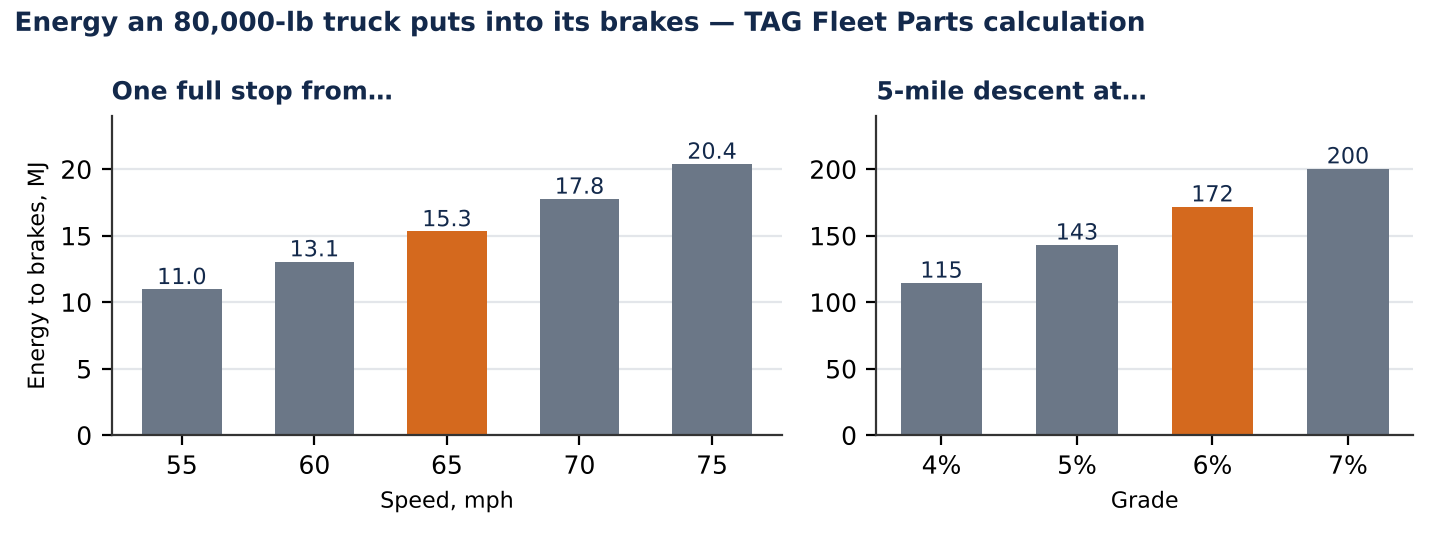
One full stop of an 80,000-lb truck from 65 mph puts about 15.3 MJ into the brakes; a 5-mile, 6% descent releases about 172 MJ — roughly 11× a stop. Phenolic binders begin to carbonize around 450°C (840°F) (Motta et al., 2023), and too much heat can cause brake fade, damage or failure; choose a low gear before the descent and use the engine retarder (SGI Professional Driver’s Handbook).
The full calculation: Brake heat and fade →
What causes brake pads to fail early in winter?
Winter deicing chemicals are highly corrosive. Through chips in the powder coat they reach the steel backing plate, corrode it, and can make the friction material crumble off (Fleet Equipment, 2022). Galvanized backing plates and mechanically attached friction resist this. Inspect every six months wheels-on and every 12 months wheels-off (WABCO, via Fleet Equipment).
Rust-jacking, stiction and prevention: Road salt and brake pad corrosion →
What is pushing pad input costs?
The Section 232 tariff on imported steel rose to 50% on June 4, 2025, and a 50% tariff on semi-finished copper products followed on August 1, 2025. Bloomberg reported on October 16, 2026 that US steel prices had reached a four-year high as tariffs squeezed imports. Steel is the backing plate and the metallic fiber in a semi-metallic pad.
How do you choose the right replacement pad?
Match the original application, confirm the edge code matches the original friction band, look for the LeafMark “N”, ask for a corrosion-protected plate with mechanical attachment, expect semi-metallic, replace at 3 mm, and compare on price per mile measured on your own trucks.
The full checklist: How to buy air disc brake pads →
What should fleets watch next?
- Air disc adoption passed 50% of North American Class 6–8 vehicles by July 2024, with Bendix investing to double its production capacity.
- California’s last heavy-duty copper extensions end January 1, 2032.
- Steel and copper tariffs at 50% remain in place.
- Brake dust as an emission: the EU’s Euro 7 agreement sets brake-particle limits of 7 mg/km for cars (3 mg/km battery-electric) and 11 mg/km for heavy vans (5 mg/km battery-electric). Euro 7 applies to new truck and bus types from May 29, 2028.
Heavy-Duty Air Disc Brake Pads: Materials, Regulation & Field Performance.
Frequently asked questions
What brake pads do Class 8 trucks with air disc brakes use?
Air disc brake pads are semi-metallic, with more than 50% ferrous content, according to Fleet Equipment. Most drum linings, by contrast, are non-asbestos organic.
Are heavy-duty truck brake pads copper-free?
California and Washington limit copper in brake friction material to 0.5% since 2025. California’s law covers heavy-duty vehicles over 26,000 lb but allows heavy-duty extensions through January 1, 2032, so check for the three-leaf LeafMark ‘N’ on the exact part.
When should air disc brake pads be replaced?
Replace air disc brake pads at 3 mm of friction material above the backing plate, and inspect every six months with wheels on and every 12 months with wheels off (WABCO, via Fleet Equipment).
How common are air disc brakes on trucks?
Bendix reported in July 2024 that air disc brake adoption on North American Class 6–8 vehicles had passed 50%, up from about 25% in 2018.
Educational content, not engineering advice. Always follow the caliper and vehicle manufacturer's approved friction specification for your vehicle.